
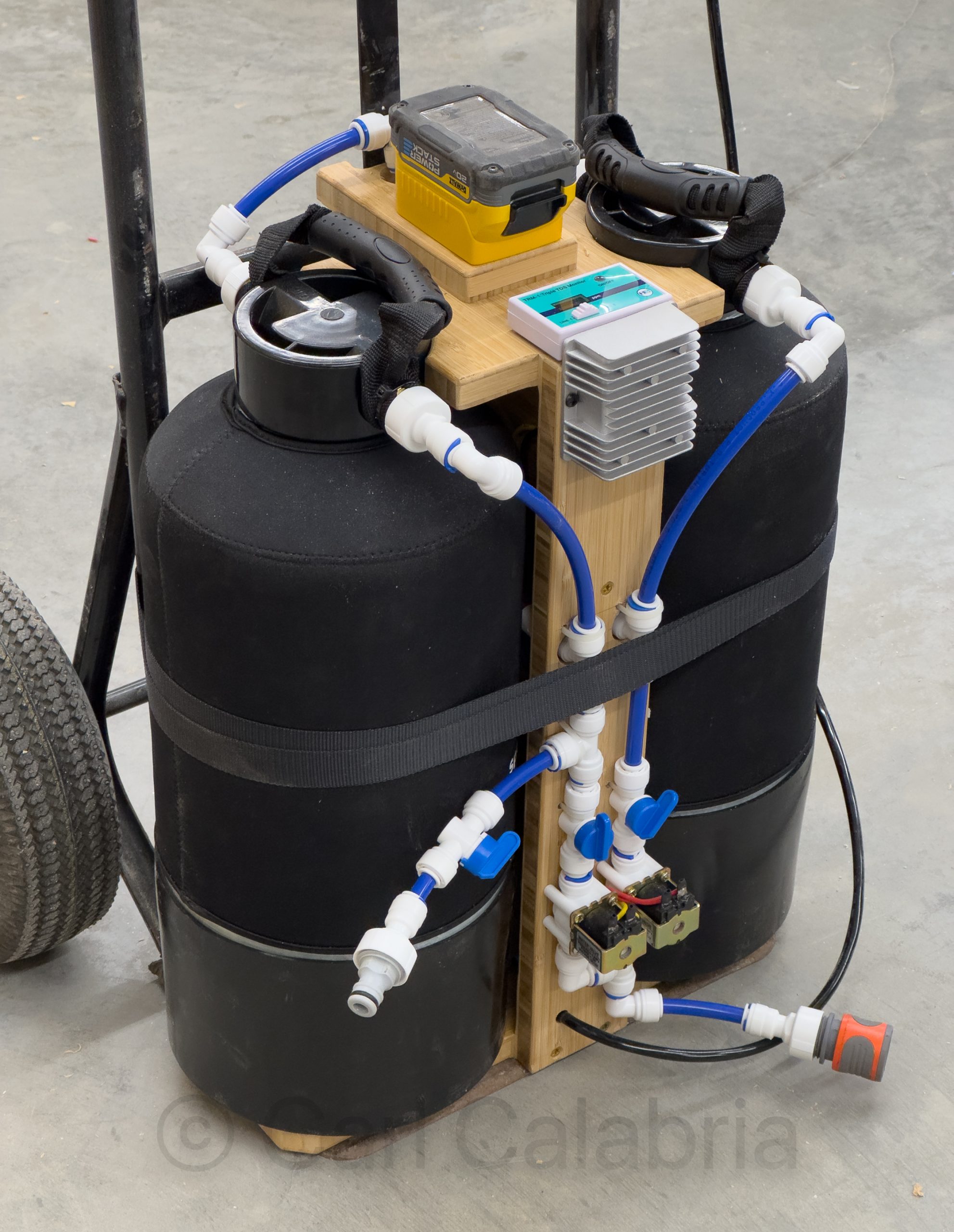
In response to a recent post about window washing, a former colleague reached out and shared his approach, which utilizes deionized water for a spot-free final rinse, replacing a squeegee with a pole mounted water fed brush. After a brief amount of research, it proved to be a superior method requiring less effort and producing better results. I identified commercially available systems using this approach, but these generally cost several thousand dollars, so I set out to build my own. The expensive bit is creating pure deionizer water. One method uses a reverse osmosis filter to do the heavy demineralization and a resin-based deionization filter to do the finishing. I opted for what is called a dual deionizer approach which uses two resin filters in series. When the first filter has reached its service capacity (400 gallons in my case, a function of the total dissolved solids in Concord water) you replace the resin inside and reverse the order of the tanks in the system. This allows you to squeeze every bit of useable filtration out of each filter while insuring an uninterrupted supply of pure water.
Pictured above is the system I built. It incorporates two 10-liter resin tanks, a three-channel TDS (total dissolved solids) meter, three flow control valves, two solenoid water valves powered by a DeWalt battery-driven 20V to 12V converter, a three-way switch at the end of a long cord, and quick-connect fittings for the water supply and output. The switch and solenoid valves allow me to use unfiltered water for extended washing and initial rinsing. When it is time for the final deionized water rinse, I throw the switch, wait 5 seconds for the water line to the pole-mounted brush to clear. Using this method of deionized water conservation, I estimate that I will use only 1/2 gallon per window. This translates to roughly 20 gallons per whole house window cleaning which I plan to do twice a year. Thus it will be 10 years before I have to do my first resin replacement at a cost of $80.
I constructed the whole unit on a wood frame that can be lashed to a hand truck for easy transportation when in use. The last thing I need to do is 3D print an enclosure for the three-way switch so that it can be mounted to the extension pole for easy actuation. The total cost for the deionizer was about $400. The carbon fiber extension pole was $250, and the water-fed brush and tubing were $250. All in, my DIY window washing system costs less than a single professional cleaning and should be a lot easier to use than my current squeegee setup.