

Jeanine hosted a lunch gathering of several women with whom she worked at Open Table. She prepared an asparagus shallot quiche with hash brown crust. It was really a work of art. I was banished to my office with the door closed, but was allowed to sample the food after everyone left.
With the S&P 500 in record-breaking territory and the state of the world being what it is, I have become increasingly concerned about the potential for a significant correction in the stock market. I spent several hours today learning about the Buffett Indicator, a ratio of the total United States stock market to GDP. Given that the stock market value represents the present value of expected future economic activity, and that GDP is a measure of the most recent actual economic activity, the ratio of these two data series represents expected future returns relative to current performance. (A bit similar to the P/E ratio of a particular stock.) It stands to reason that this ratio would remain relatively stable over time, increasing slowly as new technology creates more efficient returns from labor and capital. Historically, this indicator has been predictive of major market trends, and it currently stands at 230%, which is high.
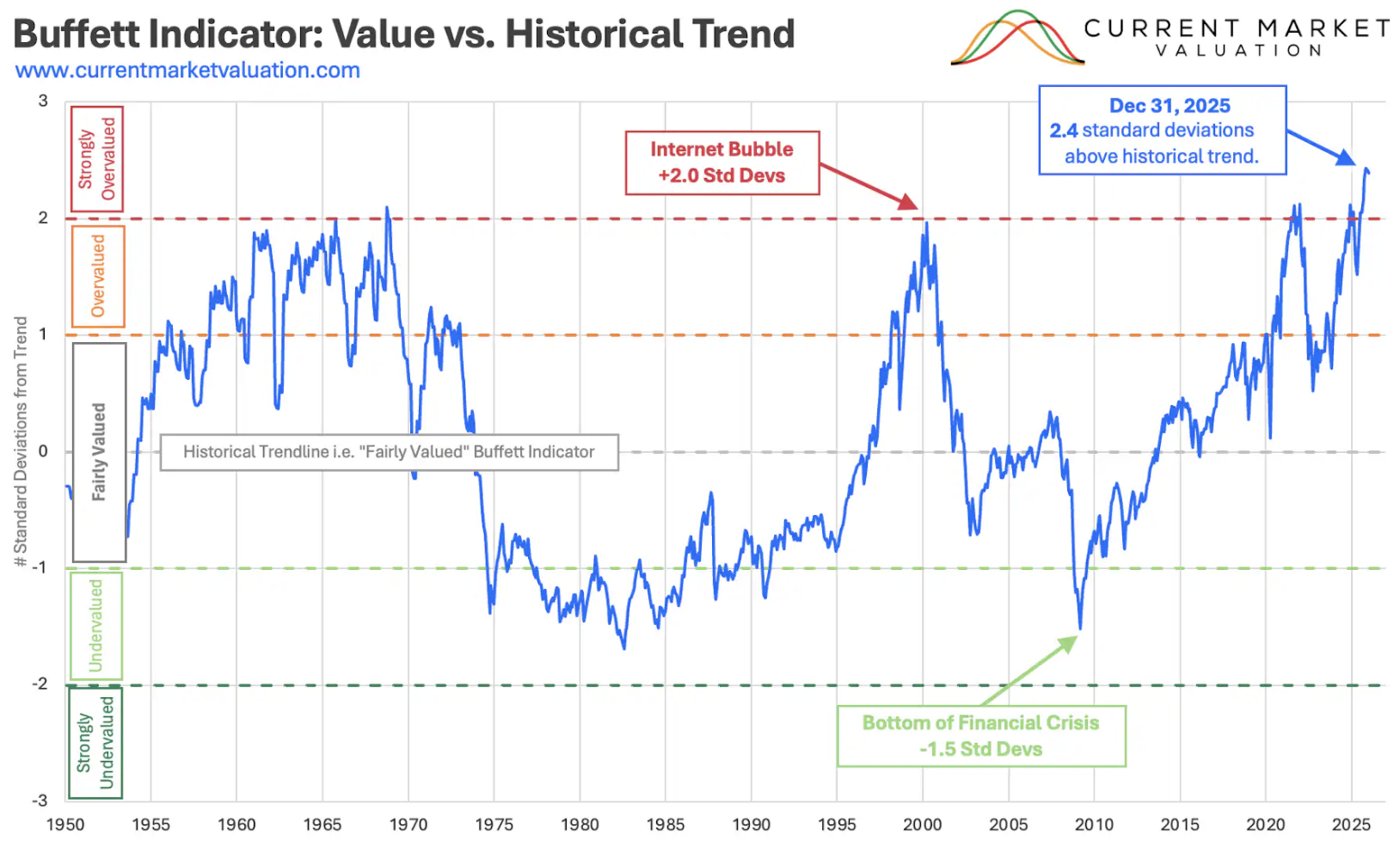
Since Buffett popularized this metric, several others have emerged that are more sophisticated. The Shiller CAPE Ratio (Cyclically Adjusted Price-to-Earnings) is often considered a superior long-term valuation model because it smooths out earnings fluctuations over 10 years, reducing the impact of business cycles. As of early this year, the S&P 500 Shiller CAPE Ratio is sitting around or above 35-38, indicating an overvalued market.
I have very little interest in the subject of macroeconomics other than to inform a good investment strategy. Today’s journey down the rabbit hole was quite uncharacteristic, but I am glad I put in the time. As a result of what I learned and after consulting with Jeanine, we made a significant reallocation of our investments in anticipation of a significant market correction over the next few years.